Call anytime

-
-
Send email
-
148 East Orangethorpe Ave
Anaheim, CA 92801
Call anytime
Send email
148 East Orangethorpe Ave
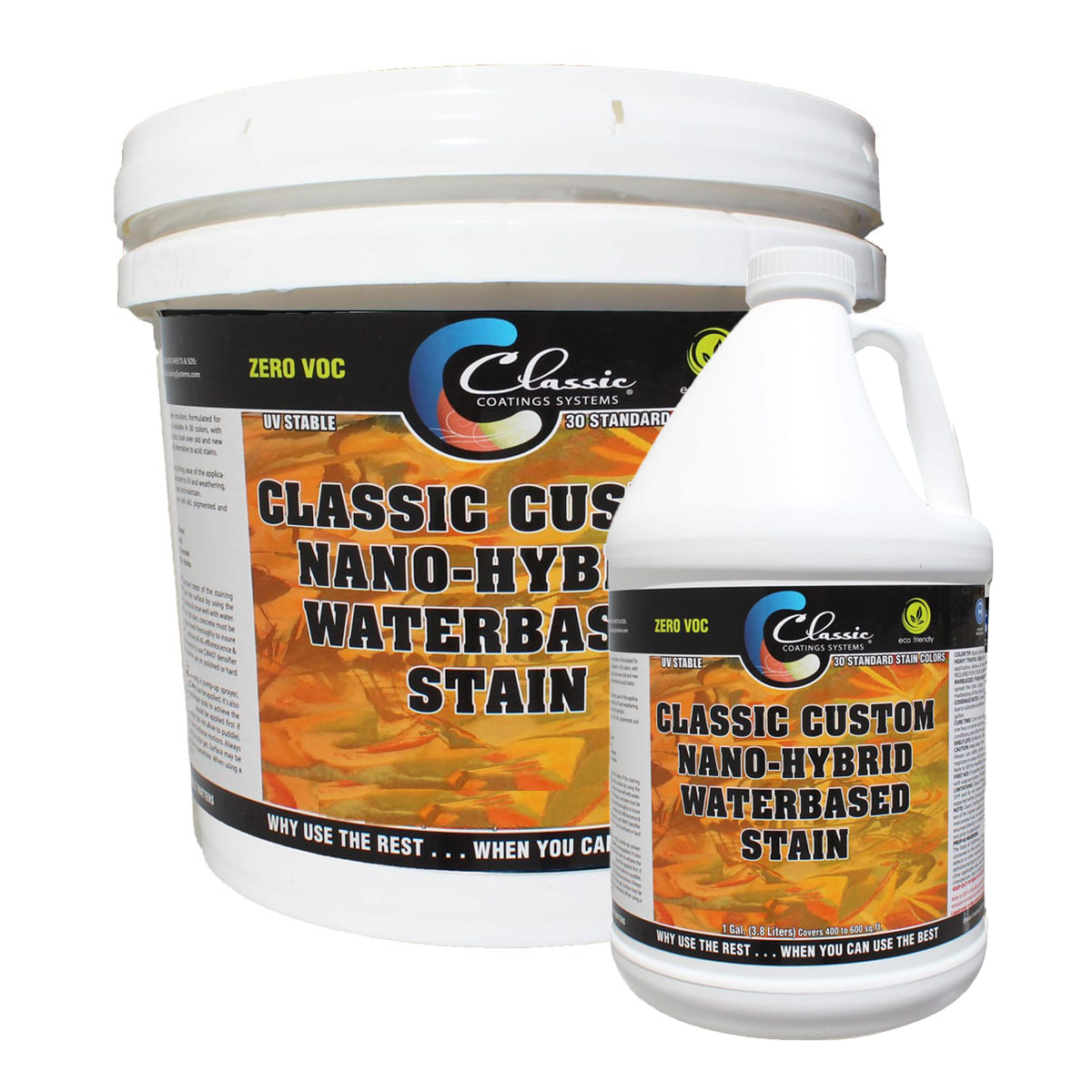
1 gallon (3.8 Liters) covers approximately 400-700 sq. ft. (2 coats) depending on application method and surface conditions.
Please note that the color swatches shown on this website are intended to serve as a close representation only. Actual colors may vary due to a variety of factors. Click here to read the full disclaimer.
Please view the Safety Data Sheet.
Traditional Water Base SDSPlease view the Technical Data Sheet.
Traditional Water Base TDSClassic Water-based Nano-Hybrid Stain is a water-based acrylic polymer emulsion, formulated for easy application and beautification of concrete and masonry surfaces. The oxides become a permanent part of the substrate.
The resulting effect creates a more opaque finish. For example, the formation of iron oxide will produce a reddish-brown mottled rust color. Considerable variations in color and tone normally result from the use of Classic Stain.
Many special color effects may be achieved using different application techniques. Classic’s color stain provides a natural art deco look over old and new surfaces, interior and exterior. Classic Custom Waterbase Stain is an environmentally friendly alternative to acid stains. New concrete must cure for 28 days before application.
Nano-Hybrid Traditional Water Base Stain Classic Water Based Stain can be used anywhere architectural concrete is desired. Both interior and exterior, on almost any cementitious surface, whether it be gray or color harden concrete, stamped or textured concrete, micro-toppings or overlays. It can be used as an entire surface colorant or just as an accent border or detail. It may be used on both new and existing substrates.
Typically used as flooring in restaurants and food service areas, bars, hotels, casino’s, retail stores, malls, art studios, movie theaters, museums, pool decks, automobile showrooms, residential flooring and more. Classic Stain may also be used as a means to color poured in place concrete; both smooth or with a form linear, tilt up wall, stoneface plaster, GFRC and faux rock.
Note: In some cases if a reaction cannot be achieved the substrate may need to be resurfaced with a cementitious topping such as Classic Micro Topping (indoor applications only) and Classic Stampable Overlay (outdoor applications only). The benefit to resurfacing is to provide a virgin canvas without the effect of patches, repairs, existing stains, mastics, glues, oils, etc.